New articles: future publication
The articles herein are derived from new information (re: Future Research) gained over the years from long lost and gratefully found family members, who have generously helped to answer many questions, closed gaps, and solved numerous missing links in relation to our family's healthy, ever growing tree.
They are shared here for posterity, further research,
and potential publication of the second edition of the book.
Please feel free to share your comments, memories and additional information
via the Contact Form below.
Thank you.
They are shared here for posterity, further research,
and potential publication of the second edition of the book.
Please feel free to share your comments, memories and additional information
via the Contact Form below.
Thank you.
Contact form: Thoughts, memories, and family photos.
David Soo Wing Kheong
Grandnephew. Grandson of Soo Hoy Hee,
Soo Kim Lan’s first cousin.
I would like to begin with a full tribute to my late father, Soo Ngoon Wye, who passed away in Melbourne, in 2008. My mom, Amy, and dad migrated with us in 1971. Mom was ninety-six when she passed last October 2020. Dad, Soo Ngoon Wye (hereon, SNW) was the elder of two surviving sons, after the loss of his elder brother to convulsions during childhood (such was the state of medicine in the early 20th century). SNW’s father, my grandfather, Soo Hoy Hee @ Soo Shak Shin, was the second son of Soo Hoong Fatt (1868-1934) and his wife, Chang Yoon Keow (1869-1920). Soo Hoong Fatt was the second son of our pioneer ancestor, Soo Fatt Seng (1832-1911).
From his late fifties on, SNW spent over ten years at his home at No. 8 Green Lane in Ipoh, to collect and correlate the information that he had on our family’s history. Not wanting to leave a stone unturned, he worked patiently and went ahead to host personal interviews, write letters, and carefully rummage through old, tattered documents. When his health began to decline, dad remained undeterred by bouts of ill-health, allowing his spirit to keep him going until he pieced together a clear, accurate sequence of accounts and felt that the work was finished, circa 1969. It is with full gratitude for my father’s efforts, and memoirs in his journal that led to this otherwise lost account, you are now reading. The following are his recollections.
Excerpts from Soo Ngoon Wye’s journal.
A fine advantage of being a migrant’s descendant, is being endowed with two pivotal versions of my family’s heritage. The first is a sort of homeland account, tabulating time and events of the family’s country of origin, in this case, China. Then, there is the expatriate version, covering times and events that setting down new roots in a new land inevitably entails. In our case, it is Malaya (renamed Malaysia, in 1963). The homeland’s account would of course have a much wider span of time-events to ponder, particularly when we consider the enormity of China. However, these details have been untraceable since circa 1850, when great grandfather, Soo Fatt Seng (hereon, SFS) decided to be a migrant, and left our family’s history to be authentically traceable, no further than to him. This gives us a relatively short span of a hundred and fifty years, over six generations.
Nonetheless, following in my father’s footsteps, with the exception of the first generation, I am glad to have a personal relationship with all six generations in my family. In itself, this gives me a comforting sense of having played my part to preserve my family’s saga. My family spent four generations in then Malaya, but when the world was opened for Asian migration after WWII, we moved to Australia. Accordingly, our family’s fifth and sixth generations are Australians.
Pioneer ancestor.
Our pioneer ancestor, Soo Fatt Seng @ Soo Pak Seng @ Soo Wooi Foo @ Soo Wai Foo (SFS), was born in 1832 at a province in Southern China. The province was within close proximity to the Great Southern Port of Canton and comprises four riverine districts known as Thong Sun, San Wooi, Hoy Pheng, and Toong Woh. The districts were so close to each other that locals describe them as, “just a sampan ride up and down opposite river banks.” To keep the record straight, SFS’s actual birth place is: Thong Hoong Chuen village, Hoy Pheng Yuen district, Kwang Toong Sang province, South China.
In 1935, my father, Soo Hoy Kee, travelled to this village and personally validated the birthplace of our earliest known ancestor. His validation is based on having found great grandfather’s name logged in their Clansmen’s Registry, which held a record of all local members (mainly tradesmen). The local record keepers consider this to be as good as a birth registry so there is no doubt, that this is our ancestral village. Sadly, no further information on our Chinese roots were possible as there were no records kept to be found. Hence, the best we can do is to theorise his early life on such grounds as points in time, customs, and conditions during rural, Mongolian ruled China.
It appears that he is unlikely to be the son of a farmer, as farmers necessarily need their sons to work the family’s fields. More plausibly, he comes from a town-dwelling family, and though academically disinclined, he had skilful hands, was intelligent, hardy, enterprising, and willing to try anything new. Living so close to the Great Port of Canton, SFS would be very privy to stories from returning expatriates, master traders, and travellers, all of which may have inspired him to set off and seek his own fortune in the world. While there were no records of his skills as a tradesman, the registry showed that in 1832, with the support and solid assurance of the Clansmen Association for any assistance he may need, a young, skilful SFS set off to find his fortune in world. At the time, China was under the Mongol Yuan rule, which forced the Chinese to wear the single braid, “Q” as a symbol of slavery. Although this practice was abolished at the Mongol dynasty’s collapse and dawn of the new government, SFS wore the “Q” for years on, and so did his children.
There is no record showing that he set off with friends, but it is also improbable that he set off all on his own, to join throngs of emigrants across South East Asia in response to aggressive developmental ventures by European nations coveting territorial rights over the region’s wealth of natural resources amongst themselves. These include the French in Indo-China; Spaniards and later, Yanks in Philippines; Dutch in Indonesia, and British in Malaya, which comprised Singapore, at the time.
During the 1850s, the lands marked for development by the British, included the rich tin fields of the districts of Larut and Matang in northern Perak, opposite Penang; and equally rich southern region, around Kuala Lumpur. Perhaps the northern districts felt more accessible to him, or he was drawn to the hive of activity at the administrative capital of Taiping, where in addition to the tin fields, large tracks of land were being cleared across the region for rubber plantations, and coconut, as a cash crop. The climate was warm, food was plentiful across this workers’ paradise for anyone who wanted to work, there were no residential restrictions, and to top it off, the British kept a good system of law and order. Hence, SFS decided on the rich, untapped, tin-fields of North Malaya’s Larut and Matang, as his destination.
He travelled aboard the Junk, a Han dynasty ship with fully battened sails, for about six months, sailing past the coasts of Vietnam and Thailand, then East Peninsular Malaya and Singapore, before heading north along the Straits of Malacca to Penang island, where he disembarked, just a half an hour boat’s ride to his self-chosen destination, today displaced by “Jambatan Merdeka,” or Independence Bridge. In March 2004, my wife, Amy and I embarked on this same route via the Queen Elizabeth II, completing the entire passage within a week. In retrospect, I feel that we, his descendants should be grateful for his decision made, as he could just as well have chosen to travel to Europe, Britain, America, or Canada, and perhaps end up in a grotto of some Chinatown.
This may sound subjective, but taking India as example, in the least, after a hundred years of colonial rule, the country emerged developed and capable of applying their colonial traits for the betterment of their people. Moreover, to the credit of the British, they returned a portion of the proceeds to their respective colonies, which also comprised roads, railways, and communication infrastructures, schools and academic facilities, a basic system of governance, equitable judicial establishment, and in my case, a good English education with opportunity for further education if so desired.
Arrival in Penang.
Now, when SFS first set foot on Penang, he lived under the wing of his Clansmen’s association, which, at the time, were renowned for their ties, worldwide- where there was a viable Chinese settlement, there you will find its Clansmen Association. Typically, assistance included temporary accommodation, meals, information on job prospects, and any other suggestions that may prove useful such as views on local customs and conventions. During this time, he received immense assistance and information, and from what he garnered, SFS decided to stay and make his fresh start on the island instead of continuing towards his planned destination at the tin-fields. No one can tell what happened next, but soon after, SFS was hard at work in a bakery. Though he lived frugally for some time, he excelled in his work and soon accumulated a small capital for himself. Living up to an old Chinese saying, “the best boss is yourself, even if you have to sell peanuts by the street, at least you are independent,” SFS used what little capital he had to set up his own fresh fruits and vegetables stall.
Early fruits of labour.
Before long, he had his own grocery business, a decent house, and was financially comfortable enough to begin looking to share his new-found fortune with a fair maiden. Circa 1860, SFS tied the knot with a lovely, Penang-island born, Nyonya girl, whose family had deeply established roots in local society, were influential, and well ingrained local organisations. This marriage established the roots of the Soo-Peranakan family ties, which blossomed over the following four generations. The couple was blessed with six children, four boys and two girls.
Whether by the island’s Peranakan connections, his good business sense, masculine Soo charm, or all of the above, his wealth continued to grow, and rivalled the wealthiest amongst those who sought and found their fortunes at the tin mines and rubber estates. In any case, SFS wasn’t someone to rest on his laurels. After twelve to fifteen years on the island, he felt a deep urge to follow through with his originally planned destination, and consequently moved to Taiping, the administrative town for overseeing the development of Larut and Matang. At the time, the town was well-established, which helped to facilitate the smooth expansion of his businesses into hard goods, machinery, and foundry parts.
A founding father’s legacy.
Over time, SFS became so well loved and respected across Taiping that it would be no surprise if the eldest amongst the elderly there can still remember him. They would talk about the old days when he would stroll about the town, flanked on all sides by his many grandchildren, who were often gleefully shopping for treats and toys. The mutual affection between SFS and Taiping grew to the extent that after over three centuries later today, Taiping is still considered our family’s founding homeland in the country.
The family’s three ensuing generations proceeded to uphold and strengthen the roots of this momentous mutual affection. Be that as it may, it is also important to note that SFS remained true to his Chinese familial roots all his life. This is self-evident in his faithful adherence to time-honoured customs at festive and ceremonial occasions. He was easily recognised about town in his stately, beautifully embroidered one-piece Chinese robes of free-flowing silk, set off in vintage fabric shoes, ethnic skullcap, and complete with his “Q” which he kept all his life, along with a long “Fu Manchu” moustache.
Soo-Peranakan blossoms.
Despite having survived two wives in succession, great grandfather never wavered in his affinity for Taiping where he explored expanding his business ventures to include the tin mining, rubber estates and fruit orchard businesses, which may well be associated with the family’s maternal Peranakan lineages. One of the most celebrated skills of the family’s highly domesticated women was their coveted skills, expertise, and creativity for presenting some of the most delectable culinary delights in the country, if not in the world. To this day, and wherever they are known, authentic Nyonya cuisines and delicacies continue to be a highly sought gastronomic delight for privileged guests and family friends.
Another well-known trait of our Soo-Peranakan ancestors was their ability to quickly adopt new language skills. This ensured their aptitude for efficiently capitalising on working with whichever dominant power that came to be, from the Portuguese to Dutch, and British during the 18th century. This remarkable competency for learning and using new languages helped to establish their repute as an integral “go-between” fraternity between the local population and its foreign administrative employers. In a way, this may be seen as one of the most impressive cornerstones leading to the Peranakan’s famed affluence in the region, despite their making up a considerably small percentage of the local population.
At home, amongst family and close friends, the Peranakan’s native tongue is a fascinating combination of multiple languages, including Chinese dialects (typically Hokkien), intertwined with Malay (conventional), Portuguese, and English. A good case in point, was my brother-in-law’s initial amazed reaction to our conversations during one of our family’s get-togethers. Dr Ng was fascinated to see us, spontaneously use three or four languages in a single sentence, and in a breath, understand each other perfectly well. In our family, we speak mostly Cantonese with dad, Hokkien with mom, and English amongst ourselves, though we are all happy with whatever came out! To my knowledge, other Peranakan families use a comparable combination, though in the earlier days, just by listening in on our conversations could impress our heritage upon others.
We may never know the reason why SFS chose to marry into an indigenous, mixed race family instead of a pure Chinese family either from his home country, or ethnic Chinese family already domiciled in then Malaya, but it appears to be the only reasonable choice for a self-made man of independent resources, in a new country of his choice. What better way to improve his circumstances in his chosen country, than to share and grow his success with someone from a long-established, local family who had her own social and wealth status? This was precisely what the Peranakan Babas and Nyonyas (sons and daughters of Straits Chinese) offered. They are a race of mixed Chinese and Malay with a smattering of European blood (Portuguese, Spanish, Dutch, and, or English) who are specific to Malaya, especially Malacca, Penang, Singapore, and Palembang in Sumatra, but the latter is now so well integrated into Indonesian society that except for their renowned culinary expertise, they have disappeared.
More about our Peranakan roots.
The Peranakan as a race came into existence circa 15th century and exist today in ever smaller numbers, though still retaining parts of their colourful past influences. 15th century Malacca was the only viable port of call to all ships plying through to and from the rich and fabulous spice islands and further on to China. It thus had a very mixed population from the sea faring nation of Europe and China who chose to settle there. As the earliest and dominant migrant population, the Chinese were amongst the first to live with natives of the fishing villages.
It was a matter of time before the Chinese population exceeded that of the local Malays, and inter-marriages became a norm. Thus, was born the Peranakan as a race. It was recorded a century or so later, that when China became a seafaring nation, the Chinese emperor recognised this port as a sea faring nation, and in acknowledgement of the status given and a token of goodwill, he made a gift of a Chinese princess with a retinue of fifty fair maidens to the Chieftain of Malacca. Not long after, the Peranakan population grew in size and established a respected foothold as a racial entity. There were still other earlier claims that Malay women made the effort to marry themselves, but over the years this was disputed, and counter reasons include, those were ‘loose’ Malay women, and it was improbable that a Malay woman would marry a non-Muslim. Regardless, a new race did come into existence.
I guess in the beginning when numbers were small, there were attempts to integrate the people into either orthodox Chinese, or Malay societies- but these were rejected. As the Peranakan population grew, they moulded their own acceptable conditions with a more flexible way of life- that of religious tolerance, a more equitable, and independent lifestyle that accommodated both their Chinese and Malay, and other relations.
Accordingly, the Peranakan adopted the Chinese ways of worship, which were not bound by any hard and fast rules, but prioritised continuity of respect, honour, and filial piety to the elders, which represents the foundation of Chinese family unity. As far as worship went, there were no restrictions at all. Peranakan could be a Confucian, Taoist, Buddhist… the list goes on, except they all lead to respect of goodness, and ultimately, the one and only Almighty. Consequently, the number of deities and festivities multiplied alongside vibrant, festive occasions for having friends and families over to share in the “good” life. At the same time, their acceptance of Malay traditions on the domestic front ensured they fitted well with their Malay counterparts and friends.
Reflections of self.
I was born on 14 January, 1925, at about 2am. This puts me under the “Year of the Rat” according to the Chinese almanac, and under the sign of “Capricorn” under the western zodiac. While much have been written about both systems of prophecies, as far as I am concerned, I have never had any interest in them until these senior years, when I can say with satisfaction, there is truth in them. No matter, I am happy with the way things have turned out for me. Given another opportunity, I would gladly give it another go, especially since my beloved, enduring wife, Amy, readily agreed to share any other journey we may have together, again. As for my sons and grandchildren, no doubt, there is a generation gap, but as a family, we have pretty good credentials, and they all know that they have an open invitation for another go with us.
Now, the arms that received me into the world were not those of our favourite GP at Ipoh’s General Hospital but were that of a seventy-year old “bedan,” or Malay midwife, who was selected based on word of mouth recommendations. This was not because my parents, that is, my father, Soo Hoy Kee, and mother, Soon Kim Foong, were inclined to spurn modern medicine, or lacked any access to good medical facilities. No, the reason is because during those days, my parents felt duty-bound to abide by traditional Peranakan customs. On top of that, as I was a Gravida 3 (third baby), it was expected that I would be easy to “catch.”
The bedan also possessed ‘magical knowledge,’ to ward off evil spirits looking to harm a mother and her new-born, knew special incantations to soothe harmful spirits, provided massages for the mother, and other skills to ensure all augured well. Hence, thanks to bedan’s capable hands, I arrived comfortably, in the privacy of mom’s bedroom at our family’s home at, No. 20 Clare Street, Ipoh, Perak, British Protectorate of Malaya. After the delivery, bedan stayed with us for six weeks, as our nursemaid, and she was happy, so long as her meals did not include any pork.
Although I had two elder sisters, my arrival turned out to be quite an event because my birth represented the customary, much-anticipated arrival of the eldest and first son of the family to uphold the traditions of son and heir into the foreseeable future.
The second generation.
Soo Fatt Li @ Soo Hoong Fatt @ Saw Ah Fatt, was born in Penang, in 1868. He was the second eldest son in a family of four sons and two daughters. He was educated at Penang Free School, an English medium school, as was customary to the Peranakan. He completed his high school in Taiping when the family moved there. Upon graduation, he and his younger brother, Hoong Choy found employment at the Hospital as “hospital dressers,” perhaps to distinguish them from female nurses. During their posts, the brothers received intensive training, which included more clinical diagnosis, emergency treatment, and Pharmacopoeia, to facilitate their services in many of the smaller, rural government clinics, as unqualified doctors.
This programme was the result of the British ruler’s attempt to overcome the shortage of trained medical personnel at the time. The dressers were encouraged to further their skills in the field, and some were offered an abbreviated medical training course. Those who made the grade were eventually registered as qualified medical practitioners. Granduncle Hoong Choy was offered such an opportunity and he soon became a medical practitioner with a successful practice in Taiping until he retired.
Grandpa was more interested in the administrative side of healthcare and after a stint of duty in various small suburban hospitals, he was made the hospital’s administrative super-intendant at Perak’s only central medical hospital, situated in the suburban town of Tanjung Rambutan. Here, he employed his skills, magna cum laude. He was highly commended, and was awarded an impressive gold watch. Upon retirement, grandpa returned to live in Taiping, at the family home, known as Spring Lodge. It was jointly built by my dad, Soo Hoy Kee, and uncle, Soo Hoy Hee, grandpa’s only two sons. Although constructed mainly with wood, Spring Lodge was a stately 2-storey private residence of about 40,000 sq. ft. nestled on an acre of land. The brothers built that home during a time when things were good in Taiping, so they splurged quite a bit.
Grandpa was an extremely talented person and inherited a bunch of good family genes. Amongst others, he was good at tailoring, moulding, and painting. He even made a clay model of his father in full regalia, which held its pride in the family home for many years. His forte is painting, and he painted a 16ft. x 10ft. wall mural on the annexe to the lounge room in Spring Lodge. The mural depicted a herd of deer in various poses, grazing and romping happily amidst grassy pasture. This was the painting that I always appreciated whenever we visited the old house, even after it was no longer our family’s home. I often nursed high hopes that this talent would somehow be retained by the younger Soo generations, so I was very happy when I saw that our two granddaughters, Lai Ling and Lai Kwan, had inherited some of this talent, a flourishing reminder of their heritage.
Grandma died in Taiping at a relatively young age of 51 years, on Good Friday, 2 April, 1920. By a strange coincidence, my mother also died on Good Friday, 1962. I never knew grandma as she passed before I was born. Grandpa remarried in 1922, and we got to know our second grandma quite well as she was relatively young when she remarried. She was the only Soo grandma that we had the opportunity to know well. She was a pleasant woman and became rather religious in her later years, spending a lot of time at the Buddhist temple in Penang.
Our grandparents lived quite a few years in Taiping until grandpa found the weather too tiring. Taiping was considered as one of the wettest towns in the state of Perak. On average, it rained 2-3 days a week, and almost all week during the monsoon seasons. They soon decided to move to Butterworth, about 70 miles north. Their home was a single story detached house, built on what appeared to be a former beach area, off the sea coast, because the ground was a carpet of small white pebbles and sand, very porous and dry. Walking barefoot there gives the sensation of walking on a beach. Still, the weather was dry, windy, and congenial for retirement.
In 1934, grandpa suffered a stroke, and was brought back to Taiping. He died within a week, at age seventy-nine, without regaining consciousness. He was buried in Taiping, close to his parents.
End. ### - ###
[Further reference: Future Research, 22 December, 2020.]
NOTES
1. Based on the Soo Ngoon Wye's handwritten entries and journal records, we found a discrepancy in our founding father's date of birth, as Soo Weng Heng addressed:
Hi PY. On reading the text again from David, I found the date of birth of SPS contradicting. On page 1 it says 1832 to 1911 but on page 2, second paragraph, it was stated SPS was born in 1817, a difference of 15 years. Could there be a typing error on the year? Assuming he was born in 1817, he would have been 94 years when he passed away. People during that era normally would not live that long and as such, I would like to think that he was born in 1832 and died at age 79... pls let me know your comments. TQ.
2. Uncle Soo Pak Heng's comments to Cousin Ying (Gan Eng Khin) after reading through this piece:
Hi Ying, Thanks for forwarding the article written by Soo Ngoon Wye that was posted by Jacqui. Very interesting and informative about the early history of Soo Pak Seng. However, there are a few errors that merit correction. The Mongols ruled China when Kublai Khan became emperor in the 13th century and the Yuan Dynasty lasted for almost a century. The Ming Dynasty supplanted the Mongolian (Yuan) in the 14th century and was in turn deposed by the Manchurian (Qing) dynasty in mid 17th century. Qing dynasty lasted until 1911 when China became a republic. So, it was the Manchu that imposed the wearing of the Q or pigtails on the male Han Chinese population and not the Mongols.
Soo Shak Shin is the alias for Soo Hoy Kee and not to be mixed up with his older brother Soo Hoy Hee. The hospital in Tanjung Rambutan, Perak where Soo Hoong Fatt worked was known as the Central Mental Hospital exclusively for psychiatric patients and not a medical hospital. Hoong Fatt was 66 when he passed away.
Thanks for all the information about what is happening here locally. You are better informed of the miserable political situation here then me so like shall not comment on them. Warm regards to Herb. -Pak Heng.
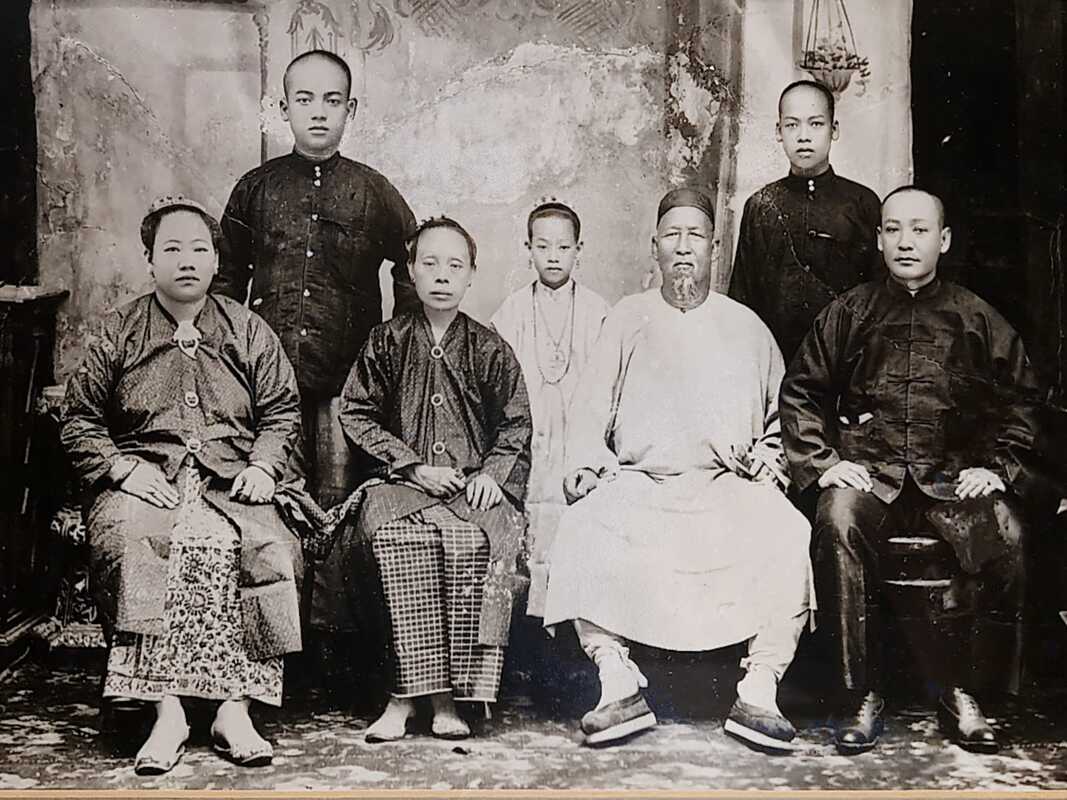 2 February 1908, Taiping, Perak.
Chinese New Year, Soo family portrait. 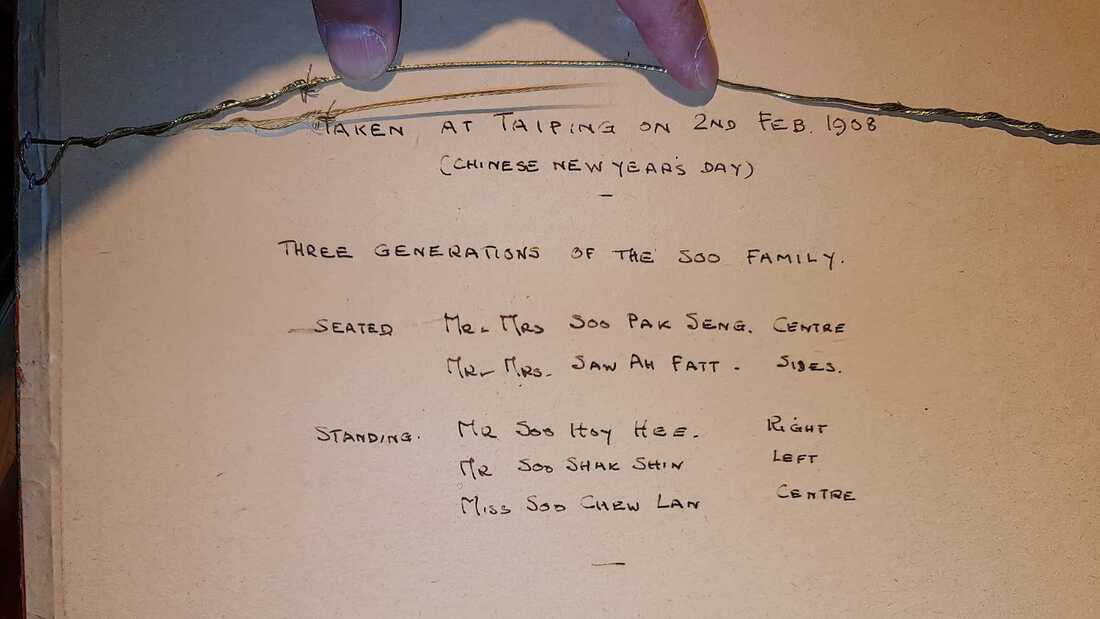 1908 handwritten description of the family's portrait. 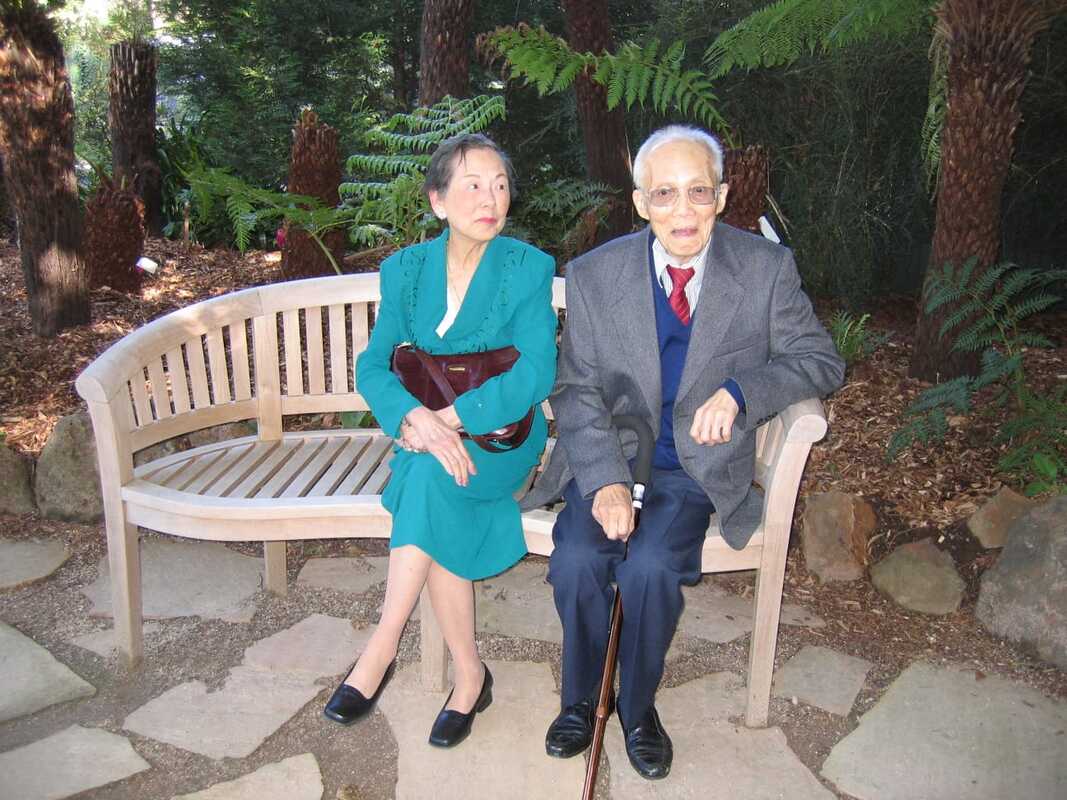 David WK Soo's parents:
Father, Dr Soo Ngoon Wye, who passed in 2008, and mother, Amy, who passed, October 2020 at 96 years. Both were laid to rest in Melbourne. Play Pause |
Chinese New Year, 1908: Soo Hoong Fatt's family portrait featuring 3 generations:
Seated, Centre: Mr & Mrs Soo Pak Seng;
Seated, Sides: Mr & Mrs Soo Hoong Fatt;
Standing, Right: Mr Soo Hoy Hee;
Standing, Centre: Ms Soo Chew Lan;
Standing, Left: Mr Soo Shak Shin.
Seated, Centre: Mr & Mrs Soo Pak Seng;
Seated, Sides: Mr & Mrs Soo Hoong Fatt;
Standing, Right: Mr Soo Hoy Hee;
Standing, Centre: Ms Soo Chew Lan;
Standing, Left: Mr Soo Shak Shin.